Three animals, no filler species
Species deep-dives with papers that exist.
v1 covers only the three the brief asked for — a lab model, an extremotolerant genome star, and a carnivore that flew on FOTON-M3. Citations are real titles. If a claim needs a DOI, follow the Sources hub rather than a fabricated link.
Hypsibiidae · model
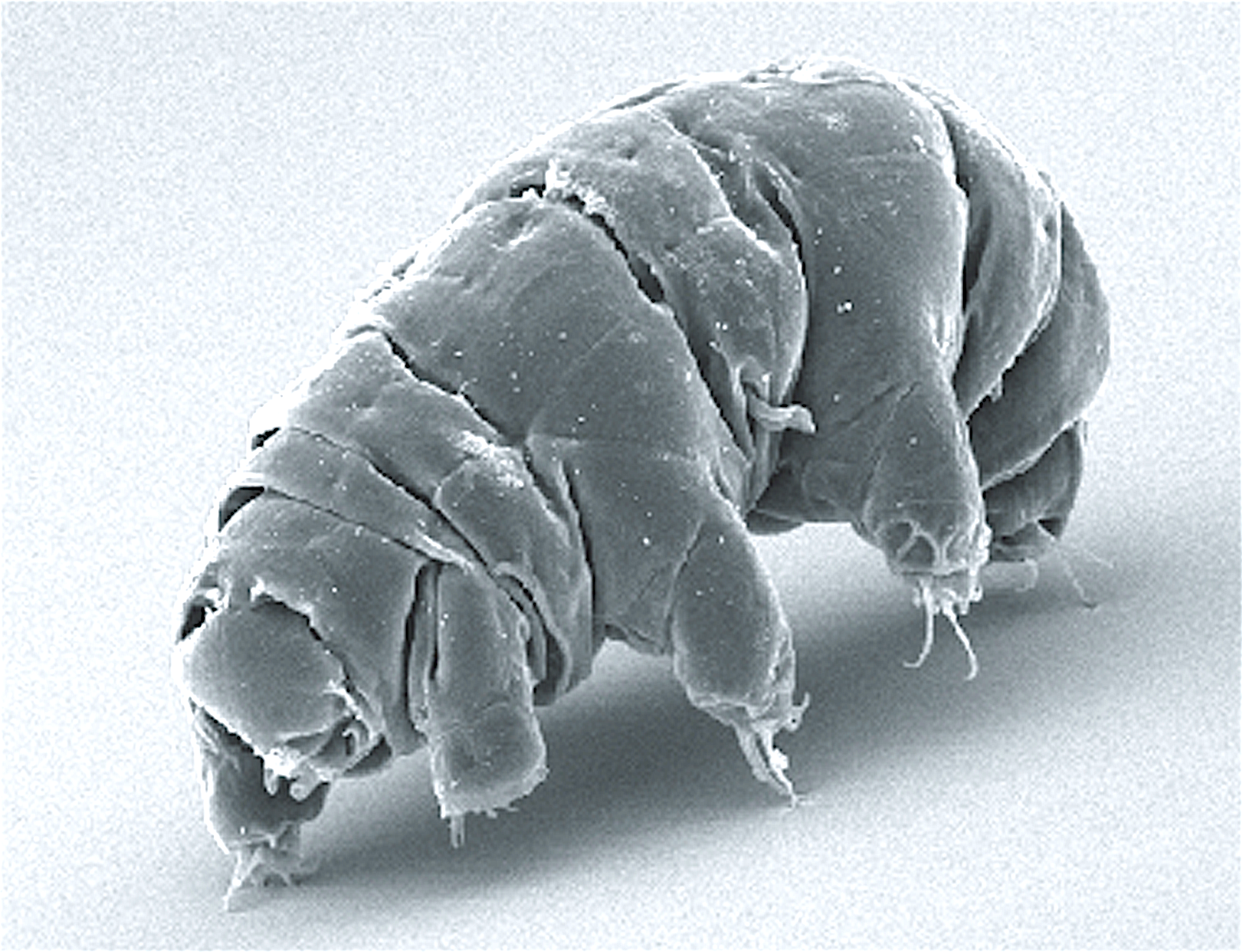
Hypsibius exemplaris
For years the go-to lab water bear was called Hypsibius dujardini, especially the Z151 culture used by Bob Goldstein’s laboratory at UNC Chapel Hill. In 2018, Gąsiorek, Stec, Morek and Michalczyk published an integrative redescription in Zootaxa and named the cultured lineage Hypsibius exemplaris — “the exemplary Hypsibius.” NCBI later updated the Z151 assemblies to that name. The wild European H. dujardini of Doyère, 1840, is not automatically the same animal.
It is small, transparent, easy to rear on algae, and photogenic under DIC. It can enter anhydrobiosis, but it is a slow dehydrator: it needs preconditioning at high humidity before it forms a reliable tun. That is the opposite of Ramazzottius varieornatus, which can dry quickly. Comparative genomics by Yoshida, Koutsovoulos, Laetsch, Stevens and colleagues (2017, PLOS Biology, “Comparative genomics of the tardigrades Hypsibius dujardini and Ramazzottius varieornatus”) used that contrast as the point of the paper.
The genome is on the order of 100 Mb (assembly nHd_3.1 is about 104 Mb). Developmental biologists use it because embryos are visible and the animal is a compact panarthropod. It is the water bear most likely to be on a lab poster, a news thumbnail, or this site’s favicon crop.
Read: Gąsiorek et al. 2018 Zootaxa; Yoshida et al. 2017 PLOS Biology e2002266; Goldstein lab pages linked from Sources.
Hypsibiidae · extremotolerant
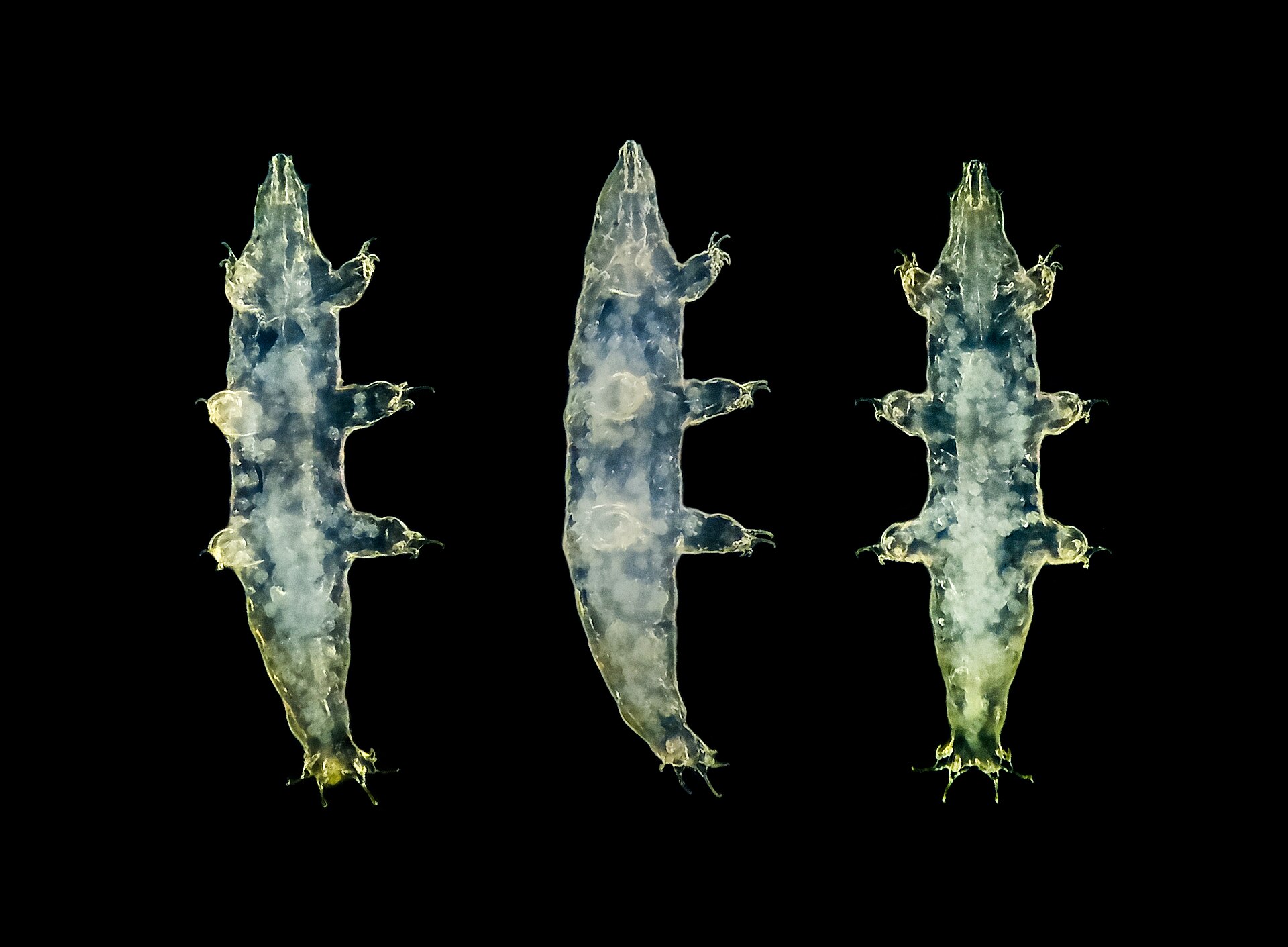
Ramazzottius varieornatus
If H. exemplaris is the friendly lab rat, R. varieornatus is the animal people mean when they say “tardigrade superpowers.” The YOKOZUNA-1 strain, established by Daiki D. Horikawa and colleagues, survives rapid desiccation. Hashimoto, Kunieda and colleagues reported a high-quality genome in 2016 in Nature Communications: “Extremotolerant tardigrade genome and improved radiotolerance of human cultured cells by tardigrade-unique protein.”
That paper is the origin of the celebrity protein Dsup (Damage suppressor), a tardigrade-unique DNA-associating protein. In human cultured cells, Dsup reduced X-ray-induced DNA damage in their assay. Later work (including Chavez, et al., eLife 2019, “The tardigrade damage suppressor protein binds to nucleosomes…”) showed nucleosome binding and protection from hydroxyl radicals. A Dsup-like protein was subsequently recognized in H. exemplaris as well.
The same genomic era named tardigrade-specific heat-soluble proteins: CAHS, SAHS, MAHS, and mitochondrial LEA-like proteins. Yoshida et al. 2017 found that R. varieornatus does not mount a huge transcriptional response as it dries — protection looks more constitutive — while H. exemplaris does a lot of last-minute transcription. That is biology, not a superhero origin story.
Heat is a weaker suit. Neves, Møbjerg and colleagues (2020, Scientific Reports) showed active R. varieornatus are vulnerable near ordinary hot-day temperatures, while desiccated animals tolerate much more, with time as a limit. Tardigrades are not heat-proof bears.
Read: Hashimoto et al. 2016 Nat Commun 7:12808; Yoshida et al. 2017 PLOS Biology; Boothby et al. 2017 Molecular Cell on CAHS gels (desiccation tolerance proteins, tardigrade).
Milnesiidae · predator · spaceflight
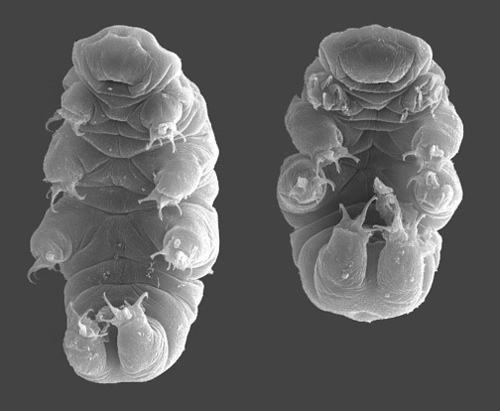
Milnesium tardigradum
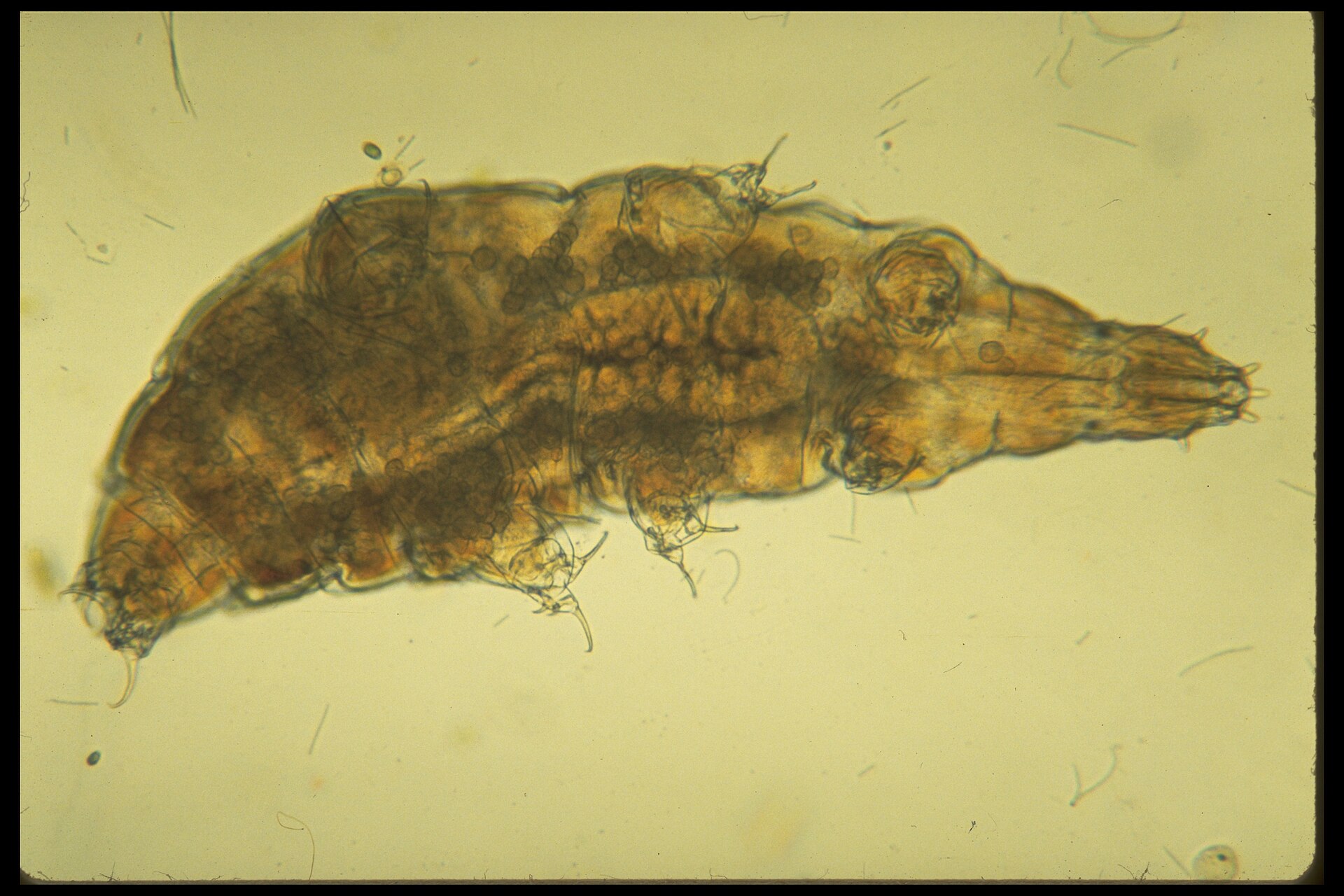
Doyère described Milnesium tardigradum in 1840. It is the tardigrade people sketch from memory: a slightly blunt, almost bulldog head, a telescopic mouth cone, and claws of the “Milnesium type” — two claws per leg, each with a long primary branch. It hunts rotifers and nematodes, not moss cells.
Taxonomy warning, because we will not pretend otherwise: M. tardigradum became a species complex. Michalczyk, Kaczmarek and colleagues redescribed it and split lookalikes; many older “M. tardigradum” records are now other Milnesium species. When a space paper or a textbook says M. tardigradum, read the strain and the date.
It is one of the two eutardigrades flown in the TARDIS experiment on ESA’s FOTON-M3 mission (September 2007), with Richtersius coronifer. Jönsson, Rabbow, Schill, Harms-Ringdahl and Rettberg reported the result in Current Biology (2008): “Tardigrades survive exposure to space in low Earth orbit.” Vacuum alone was not a massacre. Vacuum plus full solar UV was. A few M. tardigradum still recovered after the harshest UV-all treatment. That is the paper behind the sentence “tardigrades survived space.”
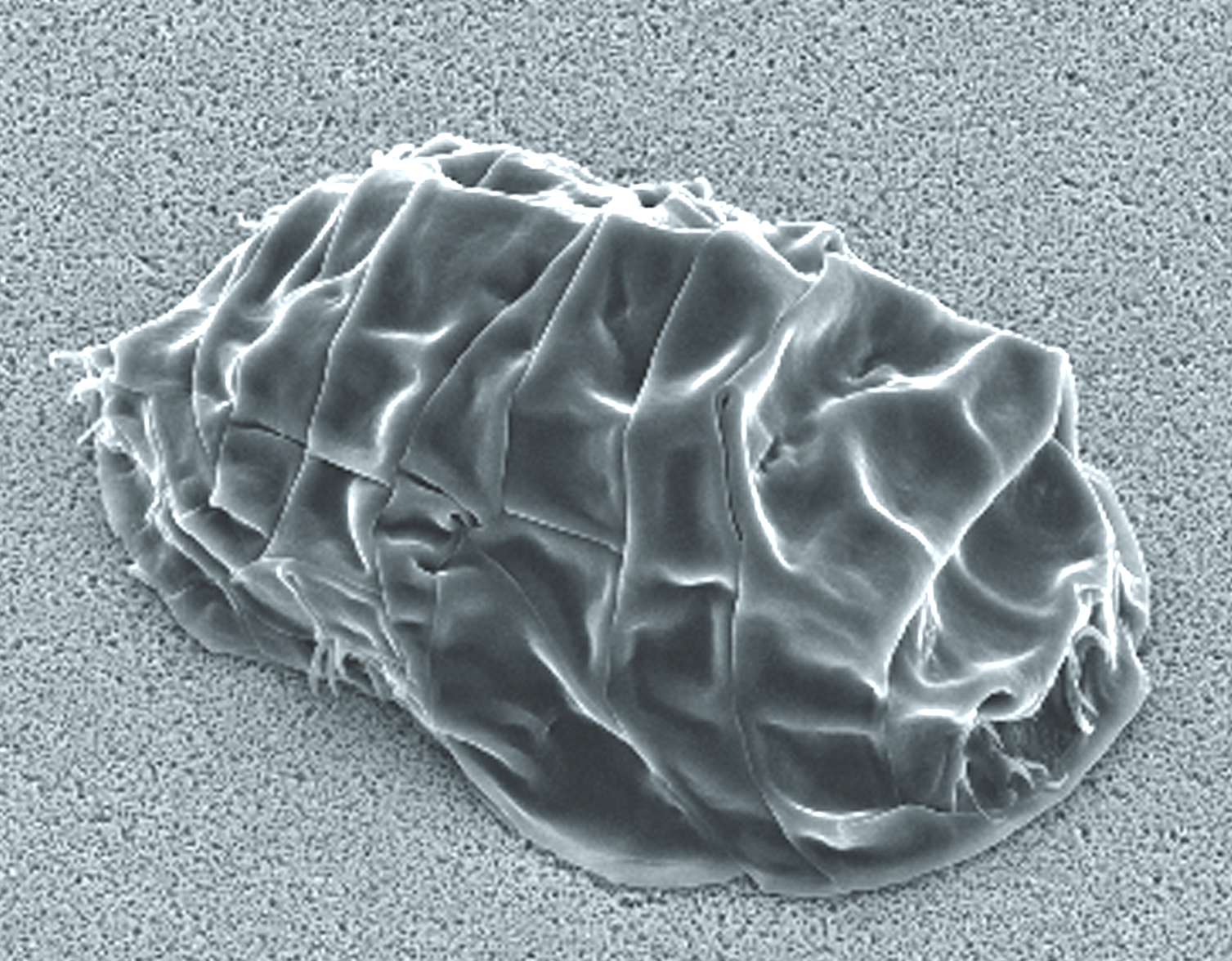
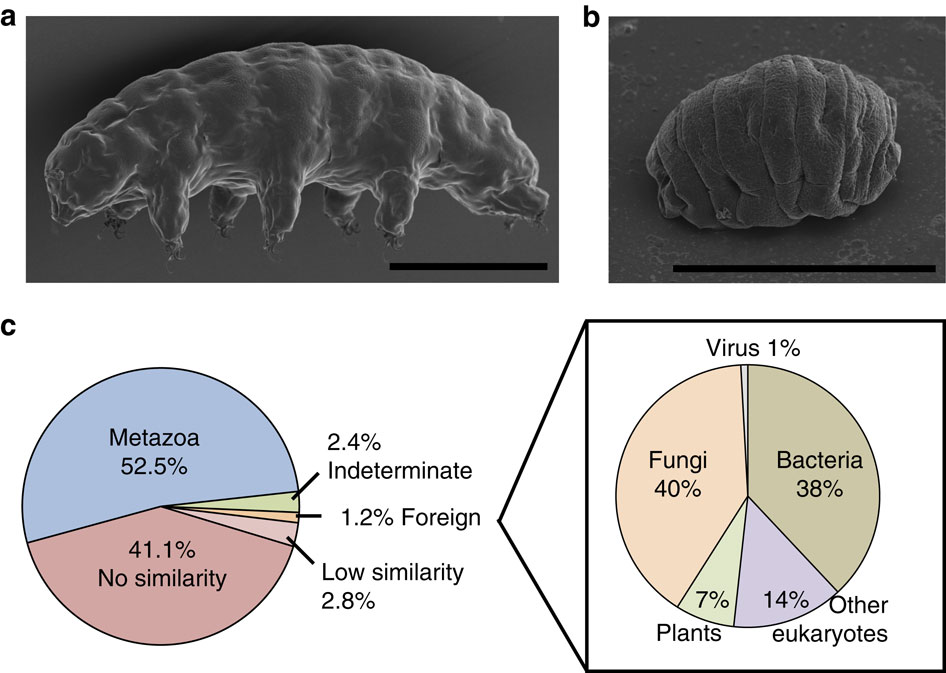
SEM plates of active, tun, and embryonic M. tardigradum from a 2012 PLOS ONE proteomics paper (Schokraie / Schill and colleagues) are on Commons and used below — tuns look like barrels with claws tucked in.
Read: Jönsson et al. 2008 Curr Biol 18:R729–R731; Doyère 1840 on tardigrade organization; Michalczyk et al. on the Milnesium redescription. Space narrative continues on Space.